Hope
The Magician's ElephantHope is the novel’s recurring wager against what seems certain: that Adele may still be alive, that a displaced elephant might find her way home, and that people can act before they possess proof that things will turn out well. It begins as a stubborn inward refrain in Peter Augustus Duchene, passes through dreams and promises, and gathers a city’s separate longings into a shared journey. Its decisive change is from an idea that Peter can barely bear to entertain into a reality he can carry in his arms.
A fragile belief under pressure
Peter first clings to hope in the form of two words: “She lives, she lives, she lives.” Yet the words do not resolve his uncertainty. If they are true, he must consider that Vilna Lutz lied about Adele; Peter has been taught to regard lying as dishonourable, especially in a soldier and superior officer. His hope therefore begins in conflict with the trust and rules that organize his life. It insists on a possibility that his understanding of duty tells him to reject.
The city offers no confirming sight. Peter steps out of a tent into a busy square, where people talk, laugh, sell, and sing beneath a grey sky, but there is no elephant. The ordinary bustle surrounds his extraordinary need without answering it. The contrast makes hope less like confidence than persistence: the absence of what he seeks does not silence the belief, but neither does belief make the absence disappear.
At the fishmonger’s, Peter is still preoccupied with Vilna Lutz’s demand that he return with two exceptionally small fish. While he waits, a customer and the fishmonger speak of a magician whose audience expected little and certainly did not expect an elephant. The customer says she has worn herself out expecting something special. Her weariness voices the opposite of Peter’s insistence: expectation can be painful, and disappointment can make wonder seem foolish. But the casual story of an elephant’s arrival also puts the impossible into ordinary conversation. Peter hears the word from another person and is so startled that he steps backward. Hope has not yet become knowledge; it has acquired a new, unsettling reason to survive.
From despair to a possible truth
When Peter looks over Baltese, he sees a city in which the elephant might be hidden, while recognizing that he has no idea how to search for her. The thought turns hope into a burden. He decides that hoping is terrible and complicated, and that despair might be easier. His difficulty looking at Vilna Lutz underscores the personal stakes: the possibility of a living sister cannot be separated from the possibility that his guardian has deceived him.
A dream changes the balance without removing uncertainty. Peter sees the door from the dream and remembers holding his sister and looking out at a field of light. He concludes that the dream is too beautiful to doubt and that the fortuneteller may not have lied. The reasoning remains tentative: if she spoke truth about Adele, perhaps she also spoke truth about the elephant. But possibility now connects two previously separate questions. Peter says aloud that the elephant is what matters, that she is with Countess Quintet, and that he must find a way to reach her so the wrong can be undone. His declaration ends not in certainty about how events will unfold, but in the conviction that Adele lives.
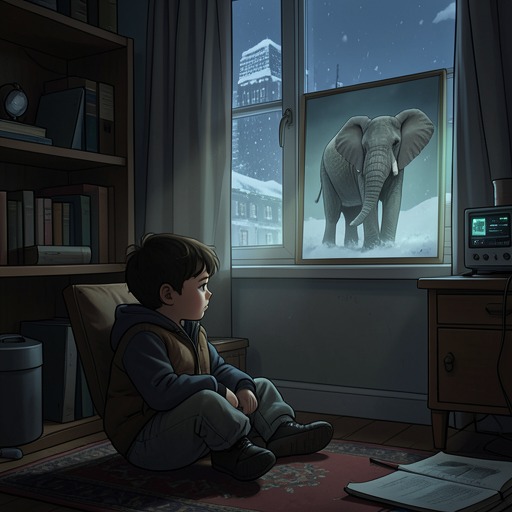
Adele’s own dreams give hope a parallel form. In her dream, the elephant comes to the Orphanage of the Sisters of Perpetual Light and asks Sister Marie for the child called Adele, saying that she belongs elsewhere. Sister Marie cannot understand the elephant’s words and closes the door. Adele watches the elephant walk away. The scene makes the distance between longing and fulfilment literal: the offer of belonging is made, but it cannot be understood or accepted. Hope is present, yet communication fails to turn it into rescue.
The dream nevertheless persists. Adele remembers the elephant’s words verbatim and repeats a sentence to herself during the day, as if it were a poem, blessing, or prayer. The repetition gives her a private assurance against the older girl Lisette’s claim that nobody intends to come for them. Unlike Peter’s wavering response to absent evidence, Adele’s hope is sustained by language she can carry with her. Its persistence does not open the orphanage door, but it keeps the possibility of being claimed alive.
Hope becomes collective
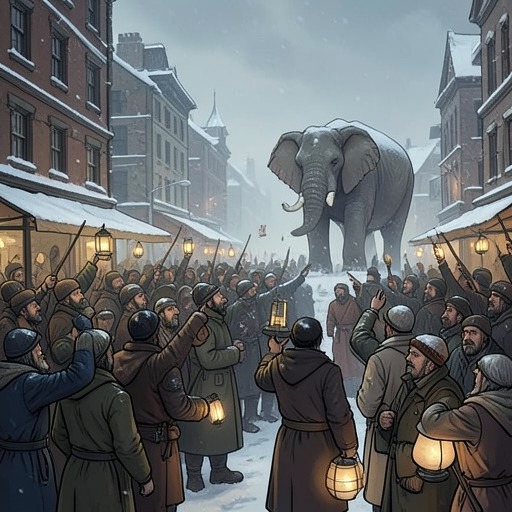
On the first Saturday of the month, the line to see the elephant stretches from Countess Quintet’s home down the hill. It contains people across ages and occupations: babies, old men leaning on canes, washerwomen, candle makers, priests, fortunetellers, lamplighters, and street sweepers. The crowd brings different hopes, wishes for revenge, and desires for love. Though its members know that merely seeing an elephant cannot truly make their wishes come true, each secretly expects that it might.
This gathering gives hope a public and communal shape. The elephant is not only the object of Peter’s search or Adele’s dream; people who otherwise stand apart wait together to encounter her. Their expectations remain unrealistic in a literal sense, but their shared attention matters. The line turns private longing into a visible social fact: the whole city has come, carrying desires that have not been satisfied by ordinary life. The novel holds both sides of the scene at once—the crowd knows better, and still hopes.
The elephant herself also experiences a change. When Peter looks at her as though he knows and understands her, she feels something akin to hope for the first time since falling through the opera-house roof. His promise that he will make sure she gets home answers her captivity not with a demonstrated solution, but with recognition and commitment. Hope here begins between two beings who cannot yet undo the situation. It is a response to being seen, and it gives the promise a recipient who can believe in it.
Belief becomes action
The promise must survive another apparent impossibility: the magician is imprisoned and weeping. Peter sees that the magician is crying too, and quietly tells him, “I believe that things can still be set right. I believe that you can perform the necessary magic.” The magician answers no. Peter’s words do not erase the obstacle or guarantee success; they challenge the despair that has made action seem pointless. Hope takes the form of an appeal to another person’s capacity to act.
The later journey to Countess Quintet’s home gives that appeal a physical shape. Hans Ickman pushes Bettine LaVaughn’s wheelchair, Leo Matienne holds Peter’s hand, and the four move quickly through snowy streets. Bettine LaVaughn calls the undertaking irregular; Hans Ickman answers that he believes the time has come. The group’s movement contrasts with the earlier solitary acts of hoping: people with different roles and reservations now travel together toward the place where change must occur.
After the rescue, Peter leads the elephant through the snowy streets while carrying Adele. Leo Matienne walks beside him; Bettine LaVaughn and Hans Ickman follow with Bartok Whynn, and Tomas and Iddo come behind them. Sister Marie is at the end of the procession, away from the orphanage door where she has spent fifty years. The group’s composition gives the return journey its meaning: the possibility once imagined in separate dreams now gathers people into a common passage through the city.
Fulfilment and significance
As Peter walks, the familiar things around him—lamp posts, doorways, trees, gates, and bricks—seem to speak the words of the fortuneteller and the hope he has carried: “She lives, she lives, she lives.” The refrain has changed its force. At the beginning it was a stubborn claim unsupported by what Peter could see; here it accompanies Adele’s warm breath against his cheek. The novel makes the confirmation intimate and bodily, not merely an idea proved in the abstract.
The ending also shows hope altering what can happen to others. After the magician has gone, Bettine LaVaughn feels a great weight break free of her, laughs, and hugs Adele. She says the child is cold, and Leo Matienne agrees that they should go inside. The practical need to take Adele indoors does not cancel the wonder of what has happened; it brings the reunion back into ordinary care. Hope’s fulfilment is not a permanent escape from material needs, but a changed reality in which the child is present and can be held.
Across these episodes, hope is neither simple optimism nor a guarantee that every desire will be granted. The crowd’s expectations exceed what the sight of an elephant can accomplish, the elephant’s first dream encounter ends at a closed door, and Peter’s belief meets the magician’s refusal. Yet the story repeatedly makes hope consequential before certainty arrives: it keeps Peter searching, sustains Adele through repetition, lets the elephant respond to a promise, and helps bring people together. Its final measure is not that wishing alone changes the world, but that a possibility once dismissed as impossible becomes the reason people move—and, at last, the truth they can touch.